<?xml version="1.0" encoding="UTF-8"?>
<rss version="2.0"
	xmlns:content="http://purl.org/rss/1.0/modules/content/"
	xmlns:wfw="http://wellformedweb.org/CommentAPI/"
	xmlns:dc="http://purl.org/dc/elements/1.1/"
	xmlns:atom="http://www.w3.org/2005/Atom"
	xmlns:sy="http://purl.org/rss/1.0/modules/syndication/"
	xmlns:slash="http://purl.org/rss/1.0/modules/slash/"
	>

<channel>
	<title>Durofy &#187; Analog</title>
	<atom:link href="http://www.durofy.com/tag/analog-electronics/feed/" rel="self" type="application/rss+xml" />
	<link>http://www.durofy.com</link>
	<description>Engineering &#38; Technology Tutorials</description>
	<lastBuildDate>Sat, 05 May 2012 02:06:00 +0000</lastBuildDate>
	<language>en</language>
	<sy:updatePeriod>hourly</sy:updatePeriod>
	<sy:updateFrequency>1</sy:updateFrequency>
	<generator>http://wordpress.org/?v=3.3.1</generator>
		<item>
		<title>Electronics Engineering - The Layers Of Abstraction</title>
		<link>http://www.durofy.com/technology/electronics-engineering-the-layers-of-abstraction/</link>
		<comments>http://www.durofy.com/technology/electronics-engineering-the-layers-of-abstraction/#comments</comments>
		<pubDate>Mon, 26 Jul 2010 01:48:35 +0000</pubDate>
		<dc:creator>Rishabh Dev</dc:creator>
				<category><![CDATA[Technology]]></category>
		<category><![CDATA[amplifiers]]></category>
		<category><![CDATA[Analog]]></category>
		<category><![CDATA[combinational circuits]]></category>
		<category><![CDATA[cpu]]></category>
		<category><![CDATA[digital electronics]]></category>
		<category><![CDATA[diode]]></category>
		<category><![CDATA[electronics abstraction]]></category>
		<category><![CDATA[electronics engineering basics]]></category>
		<category><![CDATA[electronics engineering fundamentals]]></category>
		<category><![CDATA[electronics engineering overview]]></category>
		<category><![CDATA[layers of abstraction]]></category>
		<category><![CDATA[levels of abstraction]]></category>
		<category><![CDATA[logic gates]]></category>
		<category><![CDATA[microprocessor]]></category>
		<category><![CDATA[microprocessors]]></category>
		<category><![CDATA[pn junction]]></category>
		<category><![CDATA[sequential circuits]]></category>
		<category><![CDATA[transistor]]></category>

		<guid isPermaLink="false">http://zarrata.com/durofy/?p=487</guid>
		<description><![CDATA[Any subject you learn, you first start with the fundamentals of the subject and later use them to make bigger concepts-a cluster of fundamentals. The concepts grow in size until you completely master the subject. Any subject can hence be divided into a set of layers of abstraction. The most basic concepts form the lowest layers [...]]]></description>
			<content:encoded><![CDATA[<p>Any subject you learn, you first start with the fundamentals of the subject and later use them to make bigger concepts-a cluster of fundamentals. The concepts grow in size until you completely master the subject. Any subject can hence be divided into a set of layers of abstraction.</p>
<p>The most basic concepts form the lowest layers of abstraction and the resulting devices form the higher layers of abstraction. The lower levels require the maximum effort and time while the higher levels are easy-depending only upon how well you understand the lower ones.</p>
<p>Electronics Engineering begins with Basic Physics all the way to the Microprocessor. Like any other subject, it can be summarized and over-viewed using such a set of abstraction layers.</p>
<p>
<h1>Level 1 - The Physics/The Electron</h1>
</p>
<div class="wp-caption alignright" style="width: 110px"><img title="atom" src="http://upload.wikimedia.org/wikipedia/commons/thumb/5/58/Atom_symbol.svg/100px-Atom_symbol.svg.png" alt="" width="100" height="100" /><p class="wp-caption-text">The Atom</p></div>
<p>Electronics emerges from the basics of electricity-the flow of electrons &amp; the fact that charge exists on the electron. We then take a look at the atomic view-the nature of the atom. This includes the study of energy levels and energy radiation from the atom. Once we know that elements can conduct-we can make use of the knowledge. As you may notice-this abstraction layer can further be divided into sub-levels(the electron, the atom &amp; conducting elements)</p>
<p>
<h1>Level 2 - The Semiconductor/The Holes</h1>
</p>
<p>Once we start noticing and studying the various elements-we come across the "gifted" elements of Group 4. The gift they have is a unique energy gap-one that lies between the conductors &amp; the insulators. They appear harmless at 0K-but do wonders under room temperature or when doped with another element from the 3rd or the 5th group. This classifies the semiconductors as Extrinsic &amp; Intrinsic.</p>
<div class="wp-caption aligncenter" style="width: 392px"><img title="enegery_gaps" src="http://upload.wikimedia.org/wikipedia/commons/thumb/2/2b/Gap_structure_01.png/663px-Gap_structure_01.png" alt="" width="382" height="346" /><p class="wp-caption-text">a)conductor b)insulator c)semiconductor</p></div>
<p>
<h1>Level 3-The P-N Junction/The Diode/Rectifiers</h1>
</p>
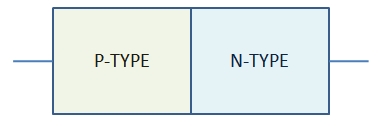
<p>Once we learn about doping &amp; the extrinsic semiconductors, we make use of the fact. The p-n Junction results. Here, we introduce a concept called "recombination". We expand the concepts of electricity to incorporate the conduction by holes-which are considered as physical positive charges. We play around with the junction-we bias it with an external voltage. It allows current only through a particular direct-it has directionality!</p>
<div class="wp-caption aligncenter" style="width: 410px"><img title="pn_junction" src="http://upload.wikimedia.org/wikipedia/commons/thumb/3/3b/PN_Junction.svg/400px-PN_Junction.svg.png" alt="" width="400" height="125" /><p class="wp-caption-text">The P-N Junction</p></div>
<p>The device resulting from the p-n junction is the Diode. It shows certain characteristics-that of conduction with directionality-and that of breakdown when reverse biased. There are a number of types of diodes-with slight variations in structure-but a greater variation in functionality. The diode emerges as a rectifier with many other applications including clipping &amp; clamping &amp; peak detection.</p>
<p>
<h1>Level 4-The Transistor/Amplifiers/Filters</h1>
</p>
<div class="wp-caption aligncenter" style="width: 485px"><img title="npn_bjt_transistor" src="http://upload.wikimedia.org/wikipedia/commons/thumb/f/fe/NPN_BJT.svg/475px-NPN_BJT.svg.png" alt="" width="475" height="200" /><p class="wp-caption-text">The Transistor</p></div>
<p>Putting two diodes back to back give us the transistor. A device used for amplification &amp; switching. It can be seen as a combination of two p-n junctions. This device has the directionality-but in addition -has gain. It is hence, an active device.</p>
<blockquote><p>Consider the layers of abstraction as layers of sand piled over each other. You are still aware of the deeper &amp; more fundamental layers-but you are now looking at the higher ones. Here, we look at the transistor and how it performs amplification/switching but we do not consider how doping results in p &amp; n type semiconductors-that is the essence of abstraction.</p></blockquote>
<p>
<h1>Level 5-The Logic Gates</h1>
</p>
<div class="wp-caption aligncenter" style="width: 487px"><img class=" " title="nand_gate" src="http://upload.wikimedia.org/wikipedia/commons/e/ef/TTL_NAND.PNG" alt="" width="477" height="284" /><p class="wp-caption-text">The NAND Gate</p></div>
<p>The transistors-alone-or combined with the diode and other passive devices lead to what are called-the logic families. They are used to realize the logic gates-devices which perform simple operations on digital signals. Amongst the logic gates-the NAND and NOR are the universal gates &amp; form the basis of most of the further levels of abstraction.</p>
<p>
<h1>Level 6-Digital Circuits/Combinational &amp; Sequential Circuits</h1>
</p>
<div class="wp-caption aligncenter" style="width: 301px"><img title="counter" src="http://upload.wikimedia.org/wikipedia/commons/7/7a/Asynchronous-counter.jpg" alt="A Counter" width="291" height="208" /><p class="wp-caption-text">A Counter</p></div>
<div class="wp-caption alignright" style="width: 202px"><img class="  " title="multiplexer" src="http://upload.wikimedia.org/wikipedia/commons/6/66/Multiplexer.png" alt="A MUX" width="192" height="166" /><p class="wp-caption-text">A MUX</p></div>
<p>Logic gates are then combined to form circuits that establish certain logic functions-they are called the combinational circuits. These include multiplexers, demultiplex, encoders, decoders and all the logic circuits you can think of that do not use a circular logic path(no feedback).</p>
<div class="wp-caption alignleft" style="width: 294px"><img title="flip_flop" src="http://upload.wikimedia.org/wikipedia/commons/c/c5/Flip-flop_SR.JPG" alt="" width="284" height="126" /><p class="wp-caption-text">A Flip Flop</p></div>
<p>The sequential circuits are combinational circuits with storage. They add a state to the combinational circuit-and they store it. They use feedback to store this state. The basic sequential device is a flip-flop and other devices include counters and shift registers.</p>
<p>
<h1>Level 7-The Microprocessor/CPU/Integrated Circuits/Micro Chip</h1>
</p>
<div class="wp-caption aligncenter" style="width: 310px"><img title="micro_chip" src="http://upload.wikimedia.org/wikipedia/commons/thumb/2/26/4012_Pinout.svg/500px-4012_Pinout.svg.png" alt="" width="300" height="300" /><p class="wp-caption-text">An Integrated Circuit</p></div>
<p style="text-align: center;">The Digital Circuits allow us to build Integrated Circuits. Our building blocks still being the NAND &amp; NOR gates. We now have functionality(combinational circuits) and storage(sequential circuit)-and those are the two things a CPU does. So, we now have the CPU. We may further have all the CPU functionality on a single chip-called the Microprocessor. The digital circuits also make way for Computer Architecture which builds the Operating System-The Computer is complete. All electronic devices we see and use everyday use a microprocessor CPU-the highest level of Electronics Abstraction.</p>
<p style="text-align: center;">
]]></content:encoded>
			<wfw:commentRss>http://www.durofy.com/technology/electronics-engineering-the-layers-of-abstraction/feed/</wfw:commentRss>
		<slash:comments>0</slash:comments>
		</item>
		<item>
		<title>Semiconductor Devices - The Half Wave Rectifier</title>
		<link>http://www.durofy.com/technology/aod-the-half-wave-rectifier/</link>
		<comments>http://www.durofy.com/technology/aod-the-half-wave-rectifier/#comments</comments>
		<pubDate>Thu, 27 Aug 2009 15:34:43 +0000</pubDate>
		<dc:creator>Rishabh Dev</dc:creator>
				<category><![CDATA[Technology]]></category>
		<category><![CDATA[ac to dc]]></category>
		<category><![CDATA[Analog]]></category>
		<category><![CDATA[analog devices]]></category>
		<category><![CDATA[analog devices basics]]></category>
		<category><![CDATA[analog ectronic devices]]></category>
		<category><![CDATA[analog electronics basics]]></category>
		<category><![CDATA[applications of diode]]></category>
		<category><![CDATA[convert ac to dc]]></category>
		<category><![CDATA[diode ac dc convertor]]></category>
		<category><![CDATA[diode rectifier]]></category>
		<category><![CDATA[diodes]]></category>
		<category><![CDATA[electronic devices]]></category>
		<category><![CDATA[half wave rectifier]]></category>
		<category><![CDATA[rectifier]]></category>
		<category><![CDATA[signal rectification]]></category>

		<guid isPermaLink="false">http://zarrata.com/durofy/?p=156</guid>
		<description><![CDATA[The diode's we've been talking about all this time do have some really cool applications in signal processing, power supply &#38; a lot of other places. And yes, the AOD stands for "Applications of Diodes" &#38; we're gonna use that for the rest of the apps as well. Diodes are used in rectifiers which are [...]]]></description>
			<content:encoded><![CDATA[<p>The diode's we've been talking about all this time do have some really cool applications in signal processing, power supply &amp; a lot of other places.</p>
<p>And yes, the AOD stands for "Applications of Diodes" &amp; we're gonna use that for the rest of the apps as well.</p>
<blockquote><p>Diodes are used in rectifiers which are devices that convert an AC to a DC signal, not a pure dc signal though... And as a matter of fact, the only source of pure DC is <strong>a battery</strong>.</p></blockquote>
<p>And this process of converting <strong>AC to DC</strong> is called <strong>rectification</strong>. Consider a simply sine wave as the input from an AC source. Then the following summarizes the overall process of rectification...</p>
<p style="text-align: center;"><img class="aligncenter" src="https://lh6.googleusercontent.com/-Y9JylryRR3M/T1QxcD5lgCI/AAAAAAAAAkA/fbIa9nzbC9E/s558/analog13.jpg" alt="rectifier" /></p>
<p>So, there is no output for the negative half as the diode is in the reverse bias condition(considered OFF). Also, the circuit we use here is just what the half wave rectifier really is.</p>
<p>Now, considering the two halves collectively, we get an output signal like so...</p>
<p style="text-align: center;"><img class="aligncenter" src="https://lh5.googleusercontent.com/--9eiv8hVJVY/T1QxcTl_VbI/AAAAAAAAAj8/mJKUw_yi9Z8/s330/analog14.jpg" alt="rectified" /></p>
<blockquote><p>Notice here that the peaks of the positive cycle appear at equal distances, and this distance is same for the input &amp; the output signal. Hence, the frequency of the signal does not change.</p>
<p>(f<sub>in=</sub>f<sub>out</sub>)</p></blockquote>
<p>Getting into the mathematical view of things, we can now calculate the RMS &amp; Average values of the voltage for our new output signal.</p>
<p><img src="http://latex.codecogs.com/gif.latex?\150dpi%20\large%20V _{rms}=\sqrt{\frac{1}{2\pi}\int_{0}^{\pi}V^{2}_{m}sin^{2}\theta%20d \theta}=%20\frac{V_{m}}{2}" alt="" /></p>
<p><img src="http://latex.codecogs.com/gif.latex?\150dpi%20\large%20V _{avg}=\frac{1}{2\pi%20}\int_{0}^{\pi}V_{m}sin\theta%20d\theta%20=%20\frac{V_{m}}{\pi}" alt="" /></p>
]]></content:encoded>
			<wfw:commentRss>http://www.durofy.com/technology/aod-the-half-wave-rectifier/feed/</wfw:commentRss>
		<slash:comments>2</slash:comments>
		</item>
		<item>
		<title>Semiconductor Devices - The Semiconductor Diode</title>
		<link>http://www.durofy.com/technology/the-semiconductor-diode/</link>
		<comments>http://www.durofy.com/technology/the-semiconductor-diode/#comments</comments>
		<pubDate>Wed, 26 Aug 2009 02:45:58 +0000</pubDate>
		<dc:creator>Rishabh Dev</dc:creator>
				<category><![CDATA[Technology]]></category>
		<category><![CDATA[Analog]]></category>
		<category><![CDATA[analog devices]]></category>
		<category><![CDATA[analog devices basics]]></category>
		<category><![CDATA[analog ectronic devices]]></category>
		<category><![CDATA[analog electronics basics]]></category>
		<category><![CDATA[diffusion diode capacitance]]></category>
		<category><![CDATA[diode as capacitor]]></category>
		<category><![CDATA[diode capacitance]]></category>
		<category><![CDATA[diode characterisctics]]></category>
		<category><![CDATA[diode current]]></category>
		<category><![CDATA[diode resistance]]></category>
		<category><![CDATA[electronic devices]]></category>
		<category><![CDATA[pn junction]]></category>
		<category><![CDATA[semiconductor diode]]></category>
		<category><![CDATA[transition diode capacitance]]></category>

		<guid isPermaLink="false">http://zarrata.com/durofy/?p=151</guid>
		<description><![CDATA[In the previous post on the P-N junction, we looked at the formation of a P-N junction. The resulting device is called a diode. The semiconductor diode is closest to the ideal diode. To study electronic devices made up of the P-N junctions, we look into their VI characteristics. The VI characteristics of a device [...]]]></description>
			<content:encoded><![CDATA[<p>In the <a href="http://www.durofy.com/technology/the-p-n-junction/">previous post on the P-N junction</a>, we looked at the formation of a P-N junction. The resulting device is called a diode.</p>
<p>The semiconductor diode is closest to the ideal diode. To study electronic devices made up of the P-N junctions, we look into their VI characteristics.</p>
<p>The VI characteristics of a device is simply a plot of the V vs I curve for the device. For instance, the resistor follows ohm's law &amp; hence, we obtain a liner VI characteristic for resistance.</p>
<p>The curve below shows the VI characteristics of an ideal &amp; a real diode...</p>
<p style="text-align: center;"><img class="aligncenter" src="https://lh5.googleusercontent.com/-4YNBDc8X2yU/T1QxaZ6HtfI/AAAAAAAAAjc/Nw4F_Rrj5LM/s497/analog10.jpg" alt="diode_charactersictics" /></p>
<p>The curve in the first quadrant represents the diode in its forward bias. The diode starts conducting at the voltage <strong>V<sub>c</sub></strong> called the <em>Cut In Voltage</em>. This voltage is about 0.6 V for Silicon &amp; 0.2 V for Germanium.</p>
<p>In case of the reverse bias, a small current flows. This current, independent of the applied voltage &amp; present only due to the minority charge carries, is called the reverse saturation current.</p>
<p>In reverse bias, the external applied voltage breaks the covalent bonds in the junction region. This leads to the breakdown of the junction at a specific voltage called the breakdown voltage(<strong>V <sub>b</sub></strong>).</p>
<p>Notice that we only consider V<sub>b</sub> in the real case. Hence, ideally, there should be almost no current in the reverse bias state, &amp; hence, no breakdown of the junction.</p>
<blockquote><p>The breakdown simply means that the diode now allows all the current to flow through it. It is just a malfunctioning of the diode &amp; not the damage of the diode. The diode is otherwise supposed to allow current through just one direction &amp; stop all the current in the other.</p></blockquote>
<p>Further, two kinds of resistances exist in the diode corresponding to the direct &amp; alternating currents respectively.</p>
<p style="text-align: center;"><img class="aligncenter" src="https://lh6.googleusercontent.com/-tTKYO8PHUzM/T1QxbPbBBHI/AAAAAAAAAjo/ohxz9RD7Gi8/s290/analog11.jpg" alt="diode_resistance" /></p>
<p>The diode can also behave as a capacitor, and even as a variable capacitor. There are two different ways of looking at a diode as a capacitor.</p>
<p style="text-align: center;"><img class="aligncenter" src="https://lh3.googleusercontent.com/-baS0nSzl4Cs/T1Qxb5kD-8I/AAAAAAAAAj4/EQG94iTGSVE/s514/analog12.jpg" alt="diode_capacitance" /></p>
<p>The current that flows through the diode depends upon the applied voltage &amp; the temperature(&amp; hence, the voltage due to the temperature). It is given by...</p>
<p style="text-align: center;"><img class="aligncenter" src="http://latex.codecogs.com/gif.latex?\200dpi%20I%20=%20I_{0}(e^{\frac{eV}{\eta%20kT}}-1)" alt="" width="227" height="43" /></p>
<p>where I<sub>0</sub> is the reverse saturation current, e is the electronic charge, k is the Boltzmann constant, V the applied voltage &amp; T is the temperature. The term kT/e is also called the voltage equivalent temperature. Also,  η is a constant = 1 (for silicon)<br />
&amp; 2 (for germanium).</p>
<p>All other diodes like the Zener Diode, LED, etc are derived from the basic semiconductor diode with a few changes in their design &amp; functions.</p>
]]></content:encoded>
			<wfw:commentRss>http://www.durofy.com/technology/the-semiconductor-diode/feed/</wfw:commentRss>
		<slash:comments>0</slash:comments>
		</item>
		<item>
		<title>Semiconductor Devices - The P-N Junction</title>
		<link>http://www.durofy.com/technology/the-p-n-junction/</link>
		<comments>http://www.durofy.com/technology/the-p-n-junction/#comments</comments>
		<pubDate>Sun, 23 Aug 2009 01:31:21 +0000</pubDate>
		<dc:creator>Rishabh Dev</dc:creator>
				<category><![CDATA[Technology]]></category>
		<category><![CDATA[Analog]]></category>
		<category><![CDATA[analog devices]]></category>
		<category><![CDATA[analog devices basics]]></category>
		<category><![CDATA[analog ectronic devices]]></category>
		<category><![CDATA[analog electronics basics]]></category>
		<category><![CDATA[barrier potential]]></category>
		<category><![CDATA[charge carriers]]></category>
		<category><![CDATA[depletion region]]></category>
		<category><![CDATA[diode]]></category>
		<category><![CDATA[diode basics]]></category>
		<category><![CDATA[electronic devices]]></category>
		<category><![CDATA[electrons and holes]]></category>
		<category><![CDATA[pn junction]]></category>
		<category><![CDATA[pn junction basics]]></category>
		<category><![CDATA[pn junction diode]]></category>
		<category><![CDATA[recombination]]></category>
		<category><![CDATA[space charge]]></category>
		<category><![CDATA[the pn junction]]></category>

		<guid isPermaLink="false">http://zarrata.com/durofy/?p=122</guid>
		<description><![CDATA[In the previous post, we looked at p &#38; n type semiconductors. These are more useful when combined together to form something called the P-N junction. The p-doped region has holes as its majority charge carriers &#38; the n-doped region has free electrons as its mobile charge carriers. Hence, the holes &#38; free electrons attract [...]]]></description>
			<content:encoded><![CDATA[<p>In the previous post, we looked at <a href="http://www.durofy.com/technology/extrinsic-semiconductors-the-doping-process/">p &amp; n type semiconductors</a>. These are more useful when combined together to form something called the P-N junction.</p>
<p style="text-align: center;"><img class="aligncenter" src="https://lh5.googleusercontent.com/-qjmZ-zvFK0w/T1QxfX73luI/AAAAAAAAAko/b0NyX2wSYAs/s381/analog8.jpg" alt="pn_junction" /></p>
<p>The p-doped region has holes as its majority charge carriers &amp; the n-doped region has free electrons as its mobile charge carriers. Hence, the holes &amp; free electrons attract &amp; eliminate each other. This process is called <em>recombination</em>.</p>
<p>Thus, due to the diffusion of the charge carriers, a potential difference gets established in the region of recombination. This potential is called the <strong>barrier potential</strong> or the <strong>space charge potential </strong>&amp; the region is called the<strong> depletion region</strong>.</p>
<p style="text-align: center;"><img class="aligncenter" src="https://lh4.googleusercontent.com/-mZ2WzNbVp8k/T1QxgsYBTvI/AAAAAAAAAk4/JnI-5K3OVF8/s369/analog9.jpg" alt="recombination" /></p>
<p>The device resulting from the p-n junction is called a p-n junction diode or simply, a <em>diode</em>. P-N junctions are also used in transistors &amp; rectifiers.</p>
]]></content:encoded>
			<wfw:commentRss>http://www.durofy.com/technology/the-p-n-junction/feed/</wfw:commentRss>
		<slash:comments>5</slash:comments>
		</item>
		<item>
		<title>Semiconductor Devices - Extrinsic Semiconductors &amp; the Doping process</title>
		<link>http://www.durofy.com/technology/extrinsic-semiconductors-the-doping-process/</link>
		<comments>http://www.durofy.com/technology/extrinsic-semiconductors-the-doping-process/#comments</comments>
		<pubDate>Sat, 22 Aug 2009 15:27:06 +0000</pubDate>
		<dc:creator>Rishabh Dev</dc:creator>
				<category><![CDATA[Technology]]></category>
		<category><![CDATA[Analog]]></category>
		<category><![CDATA[analog devices]]></category>
		<category><![CDATA[analog devices basics]]></category>
		<category><![CDATA[analog ectronic devices]]></category>
		<category><![CDATA[analog electronics basics]]></category>
		<category><![CDATA[doped semiconductors]]></category>
		<category><![CDATA[doping]]></category>
		<category><![CDATA[electronic devices]]></category>
		<category><![CDATA[extrinsic semiconductors]]></category>
		<category><![CDATA[n type]]></category>
		<category><![CDATA[p type]]></category>
		<category><![CDATA[pn junctions]]></category>
		<category><![CDATA[semiconductor doping]]></category>

		<guid isPermaLink="false">http://zarrata.com/durofy/?p=118</guid>
		<description><![CDATA[We looked at pure or intrinsic semiconductors in the previous post on Analog Electronics. We can however, change the electrical properties of the pure semiconductors by adding certain impurities to their structure, a process called doping. When doping semiconductors of groups 3 &#38; 4, these impurities are usually elements of group 3(acceptors) or 5(donors). This [...]]]></description>
			<content:encoded><![CDATA[<p>We looked at pure or intrinsic semiconductors in the <a href="http://www.durofy.com/technology/an-introduction-to-semiconductors/">previous post on Analog Electronics</a>.</p>
<p>We can however, change the electrical properties of the pure semiconductors by adding certain impurities to their structure, a process called doping.</p>
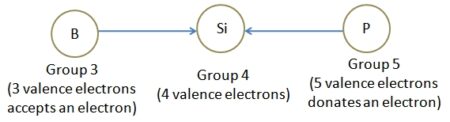
<p>When doping semiconductors of groups 3 &amp; 4, these impurities are usually elements of group 3(acceptors) or 5(donors).</p>
<p style="text-align: center;"><img class="aligncenter" src="https://lh3.googleusercontent.com/-1FHdlBMH8lk/T1QxemqcEHI/AAAAAAAAAks/Zko2952N-pI/s569/analog6.jpg" alt="donor_acceptor" /></p>
<p>This gives rise to two kinds of extrinsic semiconductors : ones having free electrons as their majority charge carriers(called n-type) &amp; those which have holes as their majority charge carriers(called p-type).</p>
<p style="text-align: center;"><img class="aligncenter" src="https://lh3.googleusercontent.com/-LVYKd8BjhQE/T1QxgxRX2RI/AAAAAAAAAk8/jW2PjKP-6v4/s434/analog7.jpg" alt="extrinsic_semiconductors" /></p>
<p>Extrinsic semiconductors are used in many electrical devices. A more useful version of doped semiconductors is <a href="http://www.durofy.com/technology/the-p-n-junction/">the p-n junction</a>.</p>
]]></content:encoded>
			<wfw:commentRss>http://www.durofy.com/technology/extrinsic-semiconductors-the-doping-process/feed/</wfw:commentRss>
		<slash:comments>3</slash:comments>
		</item>
		<item>
		<title>Semiconductor Devices - An Introduction to Semiconductors</title>
		<link>http://www.durofy.com/technology/an-introduction-to-semiconductors/</link>
		<comments>http://www.durofy.com/technology/an-introduction-to-semiconductors/#comments</comments>
		<pubDate>Sat, 15 Aug 2009 13:09:19 +0000</pubDate>
		<dc:creator>Rishabh Dev</dc:creator>
				<category><![CDATA[Technology]]></category>
		<category><![CDATA[Analog]]></category>
		<category><![CDATA[analog devices]]></category>
		<category><![CDATA[analog devices basics]]></category>
		<category><![CDATA[analog ectronic devices]]></category>
		<category><![CDATA[analog electronics basics]]></category>
		<category><![CDATA[conduction]]></category>
		<category><![CDATA[diode basics]]></category>
		<category><![CDATA[doping]]></category>
		<category><![CDATA[electronic devices]]></category>
		<category><![CDATA[electronic devices basics]]></category>
		<category><![CDATA[energy gap]]></category>
		<category><![CDATA[germanium]]></category>
		<category><![CDATA[introduction to semiconductors]]></category>
		<category><![CDATA[semiconductor basics]]></category>
		<category><![CDATA[semiconductor materials]]></category>
		<category><![CDATA[semiconductor principle]]></category>
		<category><![CDATA[semiconductors]]></category>
		<category><![CDATA[semiconductors basics]]></category>
		<category><![CDATA[silicon]]></category>
		<category><![CDATA[valence bands]]></category>

		<guid isPermaLink="false">http://zarrata.com/durofy/?p=91</guid>
		<description><![CDATA[We've often heard of terms like the Silicon Valley &#38; the Silicon Economy. What do they really refer to? All modern day electronics are build using a special class of materials called semiconductors. These materials have an electrical resistivity between a conductor &#38; an insulator. They are the foundations of all electronics which are computerized(computers, [...]]]></description>
			<content:encoded><![CDATA[<p>We've often heard of terms like the <em>Silicon Valley</em> &amp; the <em>Silicon Economy</em>. What do they really refer to?</p>
<p>All modern day electronics are build using a special class of materials called semiconductors. These materials have an electrical resistivity between a conductor &amp; an insulator.</p>
<p>They are the foundations of all electronics which are computerized(computers, ipods, etc) &amp; ones which use radio waves(radio, cell phones, etc), silicon being the heart of all these devices.</p>
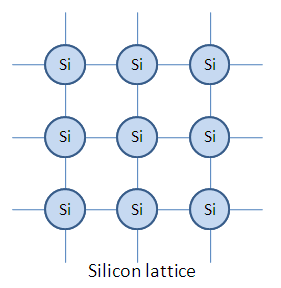
<p>The elements like Silicon &amp; Germanium having <strong>4 valence electrons</strong> are elemental semiconductors. The 4 valence electrons can easily bond with 4 neighbouring electrons to give rise to a lattice structure with no free electrons(at zero temperature).</p>
<p style="text-align: center;"><img class="aligncenter" src="https://lh3.googleusercontent.com/-lTmnCbT4vi8/T1Qxc7dDrXI/AAAAAAAAAkE/b-UXFq6pbIs/s288/analog2.png" alt="silicon_lattice" /></p>
<blockquote><p>Since, there are no free electrons at zero temperature, Intrinsic(pure/elemental) Semiconductors behave as insulators at zero temperature.</p></blockquote>
<p>Then how do they differ from insulators? Well, the difference is in terms of the energy gap between the valence &amp; conduction bands.</p>
<p>This energy gap is zero in case of conductors, very high for insulators &amp; very small for semi conductors(about 1 eV)</p>
<p style="text-align: center;"><img class="aligncenter" src="https://lh6.googleusercontent.com/-44ZQQc0LpNg/T1QxaMfdndI/AAAAAAAAAjY/uGj6BiekbHo/s537/analog1.png" alt="semiconductors" /></p>
<p>Hence, on increasing the temperature, the electrons in the valence band of the semiconductor gain energy &amp; some of them get sufficient energy to move to the conduction band.</p>
<p style="text-align: center;"><img class="aligncenter" src="https://lh5.googleusercontent.com/-FdI3xtcJDJA/T1QxdiN-8TI/AAAAAAAAAkM/QZs2Nt25LqE/s341/analog3.jpg" alt="valence_band" /></p>
<p>This is what happens physically inside the lattice. In terms of the energy bands, we could show this as follows...</p>
<p style="text-align: center;"><img class="aligncenter" src="https://lh4.googleusercontent.com/-3FDt0l4U5gA/T1Qxer6hmwI/AAAAAAAAAkg/JSKXBPasJv8/s189/analog4.png" alt="energy_bands" /></p>
<p>These electrons leave behind empty spaces called holes. The holes appear to move in a direction opposite to that of the electron &amp; hence, are the positive charge carriers of the semiconductor.</p>
<p style="text-align: center;"><img class="aligncenter" src="https://lh3.googleusercontent.com/-Qe4I3g0U1MY/T1Qxd44_1FI/AAAAAAAAAkQ/0IM-kah_bSs/s447/analog5.png" alt="hole_current" /></p>
<p>Hence, a semiconductor conducts only at high temperatures &amp; the conduction is due to both electrons &amp; holes, also, the electrons &amp; holes are equal in number.</p>
<p>However, the conductivity of the semiconductors can be changed drastically by adding certain impurities to the semiconductor materials. This process is called doping &amp; is explained in the next post.</p>
<p>Semiconductors find their major application in manufacturing transistors. The first transistor was made of Germanium. Germanium, in fact, would have more free electrons at a particular temperature than silicon. But Silicon is preferable as it can be used at extremely high temperatures.</p>
]]></content:encoded>
			<wfw:commentRss>http://www.durofy.com/technology/an-introduction-to-semiconductors/feed/</wfw:commentRss>
		<slash:comments>2</slash:comments>
		</item>
	</channel>
</rss>