Archive

Posts Tagged ‘differential calculus’

Differential Calculus - The Rules of Differentiation

March 15th, 2012 No comments

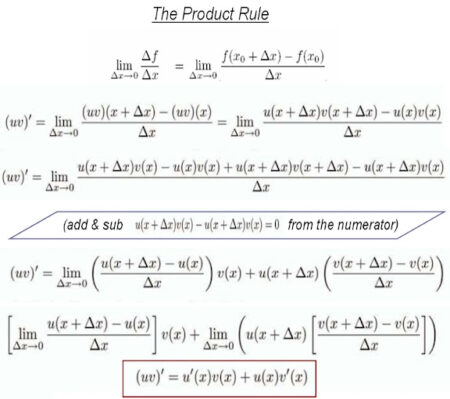
The Product Rule:
product rule

We use the Product Rule when we have products of two or more functions. In case of three functions, we take any two functions as as and differentiate the third as so on hence, forming three terms in the sum.

There is also a quotient rule for derivatives of functions in the form u/v but, we will stick with the product rule for the form u/v by treating (1/v) as a function of x.
But we should be familiar with the quotient rule too. According to the quotient rule:
quotient rule
Now, if we are dealing with composite functions, we need to use the chain rule to find their derivatives which is stated below:
chain rule
Now, using the above rules and the table of derivatives in the previous post, we can find the derivative of any function and combination of functions (applying the rules as needed).

Differential Calculus - The Basic Derivatives

March 15th, 2012 No comments

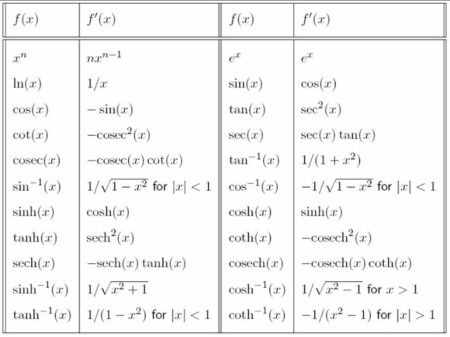
List of Derivatives of the basic functions:
basic derivatives
All these can be derived using The first principle. However, we do need to get (very) familiar with these.
To learn the basic derivatives, Practice as many questions as you can. First do the questions referring to the table here & then without it.

Differential Calculus - Differentiation Using First Principle

March 15th, 2012 No comments

So, lets see how we can apply the first principle to differentiate functions.
We'll start with the basic functions, lets take the square function first.
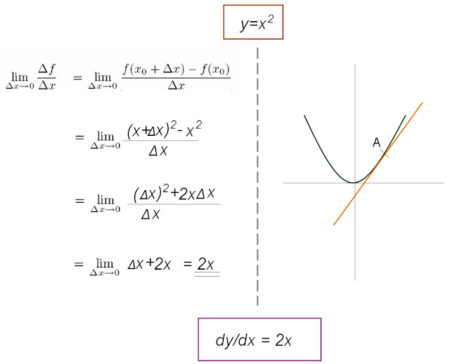
square function derivative
So the derivative of the square function is 2x which is also the slope of the tangent at any point on the curve of the function. So, for a point, x=a, the slope of the tangent would be 2a(putting x=a in 2x) And, since we know the slope of this tangent at a, we can also find its equation. Hence, we can use derivatives to find equations of tangents which is an important Application Of The Derivative.

Now, lets differentiate another function using this principle. We'll go for the rectangular hyperbola this time.
rectangular_hyperbola

Now, lets find out a generalization for such functions(polynomial/rational & irrational).
algebraic derivatives
We considered the value (phi) to collectively consist of all the higher powers of the change in x as the terms with higher powers would eventually cancel out while solving the limit.
Hence, this is the actual method for finding derivatives of functions - the first principle. However, in practice, we use properties of derivatives and the basic derivatives of the most common functions to find the derivatives of bigger and more complex functions. First, we must be aware of the derivatives of the major and most common functions.

Differential Calculus - The First Principle

March 15th, 2012 No comments

In the previuos topic, we found out the slope of the tangent which was the derivative of the function, we had actually found something called the first principle of calculus!
first principle
So, the thing in the red box there is the first principle which we will use to find the derivatives of a function. This process, of finding derivatives(notation:dy/dx) or the differential coefficients of functions may be called Differentiation & we are said to differentiate functions while finding the derivatives.

Differential Calculus - An Introduction to the Derivative

March 15th, 2012 2 comments

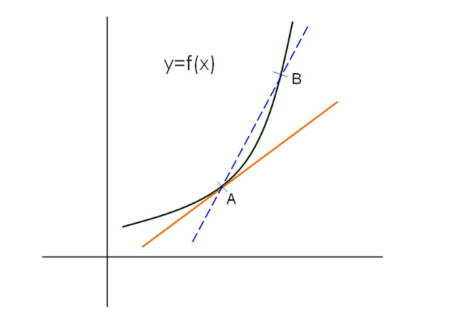
function

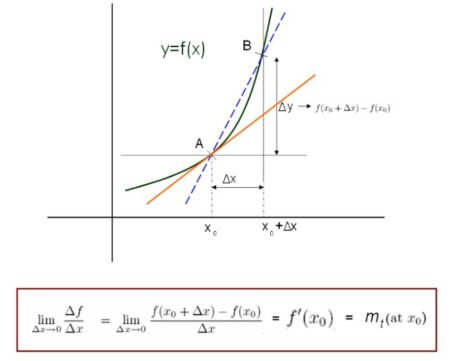
The function y=f(x) in green, is associated with two lines in the above diagram. The line there in blue cuts the function at two points while the line in orange touches the curve at a single point. With some of our previus knowledge, we would say that the line in orange is the tangent line as it touches the curve at one single point. The statement IS ture, but does it mean that the tangent cannot cut the curve furthur at another point?
Well, the figure below answers the question.

sine tangent

Here, we see that the tangents at P & Q do intersect the curve of the sine function again at other points. We also notice that the curve has the same nature between point P & the point 3pi/2 & the tangent intersects the curve on the left of 3pi/2, ie when the curve has changed its nature! We find the same observation for the tangent at Q. So, for any curve, the tangent may intersect it again at a point provided the curve has changed its nature atleast once between the new point of intersection & the point of contact of the tangent.

So, that was about the orange(tangent) line. Lets talk about the blue line. Have you seen something like this before? Sure you have. Have a look at the image below.

circle

So, this line in red on the circle, and in blue on the function, is called the secant line. Now, lets try to find ut the slope of this secant line.

secant slope

So, the slope comes out to be (the change in y)/(the change in x) & here, the change in y refers to the difference between the value of the function at A and its value at B, which is:

change in y

Hence, The slope of the secant line can be written as:

slope of secant

Now, we need to get the orange line into the picture, keeping the blue line in mind.

tangent secant slopes

Now, Lets take our observation a step furthur. You can observe in the figure below, that when the above happens, ie when A gets closer to B, the change in x goes on decreasing and finally, tends to zero when the slopes tend to be equal, or when A & B tend to coincide.

aprox slopes

So, we basically have limiting values here which calls for the application of limits.
And that limiting value there folks, is the derivative!

slope of tangent derivative

Differential Calculus - Graphical Transformations

March 15th, 2012 No comments

Graphical Transformations help us to plot any function in calculus.
These transformations can easily be observed by changing the values of the independent variable x.

shifting function 2


shifting function


scaling function


negative 3


negative 2


negative 1


modulus 4


modulus 3


modulus 2


modulus 1


greatest integer 2


greatest integer 1

fractional part 1

fractional part 2


inverse function

Differential Calculus - Functions & Graphs

March 15th, 2012 No comments

Before we study differential calculus, it is important to understand the concept of functions and their graphs. This is a major pre-requisite before any Calculus course often dealt with in a separate course called Pre-Calculus.

The Concept Of Functions, Domain & Range

Lets say we have a circle. The area of this circle depends on its radius. Hence, we have an example where a quantity depends on another. Thats exactly what the concept of a function is. Here, the area depends on the radius & is said to be ‘a function of the radius’. The area, hence, is also called the ‘dependant variable‘ while the radius being independent is called the ‘independant variable‘. Now, depending on whatever value of radius (the input) is, there is a corresponding value of the area(the output).

Every single machine in the world, works on the concept of a function. We give the machine an input & it gives us an output. Lets take a washing machine for example, we give it dirty clothes(the input) & it gives us clean clothes(the output). But, what if we leave our cell phone in our pants while giving it to the machine. It will not execute the function. You will get an output for the clean pants BUT NOT for the cellphone even though they are together.

This means that the washing machine is not programmed to take in the cell phone as an input or we say, the cellphone does not fall into the domain of the machine. Hence, the domain of a function consists of all the values that can be given to the machine as the input & the range are the values of all the ossible outputs obtained from the machine.

Mathematically, a function is described as y=f(x) where x is the input or the independant variable & y is the output or the dependant variable as explained above. Hence, all possible values of x form the Domain of the function & the corresponding output values of y form its Range.

Here is a table where functions are classified into 3 main categories based on their nature.

types_of_functions_calculus

Algebraic Functions:

algebraic_functions

Modulus Function:

modulus_function

Fractional Part & Greatest Integer Function:

fractional_part_greatest_integer_function

Signum Function:

signum function

Trigonometric Functions - Sine & Cosine Functions

trigonometric functions 1

Trigonometric Functions - Tangent & Cotangent Functions

trigonometric functions 2

Keeping these basic functions & their graphs in mind, we will move on to Graphical Transformations

10 Steps to Ace Calculus

June 29th, 2010 No comments

Dried Beans...CALCULUS. Woo...Well, its basically pretty conceptual & if you follow the ten step that follow, you'll be in a better position to ace calculus!

Do remember that these are steps and not ways to ace calculus. So you'll need to go step-by-step. You can move on to the next step only after the execution of the first(mathematicians are programmers).

1. Ace PreCalculus Your precalculus must be very strong if you want to move on to Calculus.

To strengthen PreCalculus, you'll need to master:

  • Algebra
  • Trigonometry
  • Geometry
  • (including equations & inequalities, trigonometric identities, conics, the binomial theorem, sequences & series.)

    If you're planning to take up multivariable calculus as well, you also need to build up concepts of:

  • Vectors
  • Parametric coordinates & equations
  • Matrices
  • as a part of precalculus itself.

Now, once you are able to see functions all around you...you're ready to go!

2. Functions are Calculus The first course I took up for Calculus was a 6 month course. My instructor took 4 months just to teach functions & their graphs! That was scary, I had a competitive exam & I had to complete the rest of it in 2 months. Surprisingly, we could do it in half the time! When the functions are with you, Calculus is with you. The rest is just application of functions. But, you need to be very good with them & especially with their graphs which help a lot in giving you an insight to the problem. You can visualize the problem what you're being asked for how to get it if you take a look at the graph of the functions involved in the problem. To be a master of functions, know their nature. Their likes, dislikes & hobbies. Okay, technically you need to know their domain(they want these for the x), the range(they give these y's) & theirbasic properties(the graph tells it all).
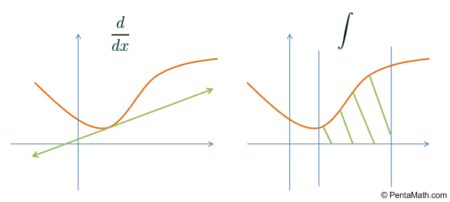
3.Understand the Basic Principles Yes, its now time to know what you are trying to ace...Calculus. To understand the basic principles of Calculus, you jest need to ask yourself three questions: What. Who. Why....And the answer is the same... Mr. Newton & Mr. Leibniz gave us: calculus basicsOn your left is what we call the derivative(represented by d/dx or y' or f') which gives the slope of the tangent to the function at a point. Say you have the function f(x), then the slope of f(x) at x=a would be f'(a).

the derivative

On the right is the integral of the function between two points(represented by the two lines without arrow heads) which gives the area under the curve of the function between these two points.

integral

4. Learn to Apply The Basics One you understand the above basic physical significance of calculus(integral & differential), you should learn ow to use it to solve problems. In any calculus problem, You'll be asked to find one of these... m(slope) or A(area) directly or inderectly. Once you know the significance of the integral & derivative, solution comes to you.
5. Understanding The First principles Lets now take up the derivative. We talked about its physical significance, but how do we compute the derivative? Well, we use something called the first principle. It directly gives us the derivative of a function & we can plug in different values of x into this derivative to get slopes of tangents at varius points.

first principle

And this is what we use to obtan the basic derivatives... You must derive all of the basic derivatives of common functions(the ones you find in any genuine basic derivatives table). And yes, you may also derive the basic rules of differentiation(sum/product/quotient) using the first principles. You must practice a lot of problems on differnetiation to learn the derivatives of these functions & then extend the to any possible function using the rules of differentiation.

6. Apply those Derivatives Once you are able to differentiate any function that you come accros, you would want to apply these derivatives in real time. So what can they be used for? A)You can use these for finding slopes-something you're already familiar with. The derivative itself is the slope of the tangent at a point. What next? You can then find the equations of tangents & normals using their slopes. B)Derivatives can be used for finding maxima & minima of functions-derivatives can be used to find extremum by examining the slopes of tangents. Take a look at this curve below, you'll find that the slope of the tangent vanishes(tangent becomes parallel to the x-axis) at points of minima & maxima.

extrema

All the x's corresponding to these points(slope or derivative=0) are the points of extrema & the corresponding y's, the maximum & minimum values of the function. C) The third thing derivatives help us with is determining the nature of a function or curve. We can find the intervals in which the function increases or decreses. Take a look at the image below. You'll observe that the slope of the tangent is positive whenever the function increases while the slope is negative when the function decreases. Yeah, I know exactly how you feel!

monotonicity

Now the tangents 1 & 2 have a positive slope(observe that the angle they make with the x-axis < 90 degrees) & the function is increasing. Also, the tangent 3 has a negative slope(angle < 90 degrees) & the function is decreasing. Apart from the above, you can also use derivatives to sketch curves, in approximations & finding physical rates of change(which is what differential caluclus is all about).
7. Reverse the Process of Differentiation
Next, we need to reverse the differentiation process to obtain what is called the anti-derivative or indefinite integral. Indefinite, because of lack of the physical dimension to it. If the derivaive of a function f(x) is F(x), then the integral of F(x) is f(x). Thats all it means. You'll be able to get a deeper insight if you look at a genuine table of integrals. Knowing some of the basic integrals, you can use various methods of indefinite integration to find integrals of almost all functions. Yes...there is a reson why I used any function in case of differnetiation & alomost any function in case of anti-differentiation. The reson is simple. You can differentiate all functions(not considering specific values) but you cannot integrate all functions. There are a few non-integrable functions.
8. Add Sense to the Anti-Derivative Its now time to go definite! This is easy, just take the anti-derivative of the function and plug in the values of the points which enclose the area.

areas under curves

As you see here, you may find area under a curve or the area between two curves(subtract the two shaded areas in the image).
9. Put Everything Together Put the two of them together. What do you get? Rates of Change & Areas under curves going hand in hand? Weird? But thats what calculus is all about. Thats the whole beauty of calculus. We come across a lot of weird & beautiful relation in math & Calculus gives another one. You might now wish to do some basic differential calculus to see how exactly the two process of differentiation & integration are related to each other. When you mix em' up together, you'll get what is called a differential equation.
10. Practice & Keep Smiling . Ok, i just reduced it to 9. Good Luck. Keep Smiling! Keep Practicing!